The maharajah was having a nightmare. He often did since he left the hurly burly of Nepalese politics for a life of a
raj-rishi with determination to devote the remaining few years of his life in spiritual pursuit. He dreamt of a calamity striking Nepal and taking him in its wake. Although not residing in Kathmandu any longer, he was still close enough to feel the ripples of a revolution should it come sooner or later, but come it would. The maharajah woke up sweating. He asked his attendant to light up his hookah. This would make him calm again.
 |
| Ridi Bazaar on the banks of Kali Gandaki River |
Ridi is a very holy place in Nepal. Located at the confluence of the small Ridi stream and the larger Kali Gandaki River in Gulmi district, the site is acclaimed far and wide as a pilgrimage site as holy as Benaras. Throughout the ages pilgrims not able to reach faraway Benaras flocked to Ridi for salvation. The famous temple of Rishikesh founded by King Mukunda Sen graces the site. Nearby, only 5 km away on the spur of a hill overlooking the Kali Gandaki River and the famous temple, Juddha decided to build his retirement home at a place called Argali. This is the place the retired Maharajah Juddha had chosen to live the life of a
raj-rishi embracing the virtues of abstinence and meditation. Still his mind was not at complete rest.
 |
| Dilapidated Argali Durbar today |
How soon the
bharadars, the courtiers, who were singing praise to the maharajah and extolling his virtues were no longer in sight although Argali was but a few miles to the west from Kathmandu. Power had now passed from the
Raj-rishi Maharajah Juddha to the new prime minister Padma Shumsher, his nephew. Padma occupied Singha Durbar. Used to the trappings of absolute power with hordes of people swarming his palace to offer obeisance, it was rather lonely now at Argali admitted the Maharajah to himself. The Durbar was gone. Only his youngest wife Kanchi Maharani was there. Even the children from her had grown up and were living independently in their own
bhawans in Kathmandu built for them by the Maharajah. This was his own doing of course reflected Juddha. He had voluntarily resigned from the powerful office of prime minister and the title of Maharajah of Kaski and Lumjung, the only Rana ruler ever to do so. He was the
de facto ruler of Nepal for 13 long years like his Rana predecessors had been since 1846 A.D. as the Kings of Nepal were mere figureheads without any political power. And he had given it all up.
He had his innings at the helm and he was proud that he did the nation a great service after the devastating earthquake of 1990 B.S. He had mobilized all resources at his disposal and rebuilt. He had denied foreign aid for reconstruction as this would invite intervention in the internal affairs of Nepal. He had continued the policy of his predecessors in assisting the British government and so during World War II he offered Nepalese troops to fight for them in Burma. He had sent his own sons to the front leading these armies. He started mills and industries in Nepal, banks to finance them and an insurance company to mitigate calamity. He made a zoo in Kathmandu to the delight of the populace. He made innumerable rest houses for pilgrims and renovated temples and monasteries. But there had been failures too he reflected sadly. He had taken out from the Roll of Succession his nephews, sons of his predecessors Maharajah Bir and Bhim from their junior wives. This had created a great friction in the ruling family and destabilized it. These nephews had now funded the nascent democracy movements from their safe havens in Calcutta. These movements for democracy had put him in a corner. He had to sanction the harsh measure of capital punishment meted out to some of the ringleaders of these movements following the clamor from inside his inner ruling circle.
 |
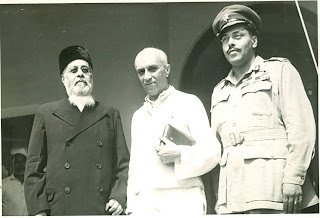
My father Gen. Kiran with Maharajah Juddha and Pandit Nehru
|
It was time now to leave Argali, leave Nepal altogether and seek solace in the Indian Himalayas. The year was 1948 A.D. Weighing his many options he finally decided on Dehra Dun capital of today's Uttarakhand State of India. These areas belonged to Nepal before the 1816 A.D. Treaty of Sugauly when Nepal had to give up significant territories to British India following a brief war. Places such as Dehra Dun, Nainital, Almora and Garhwal were still home to the Nepalese diaspora. There Juddha would feel at home away from home. Where would he stay though? Prime Minister Pandit Nehru and Home Minister Sardar Vallabh Bhai Patel of India invited Juddha and kindly offered him a temporary residence before he could complete his own abode. He decided to call his son General Kiran Shumsher J. B. Rana from Nepal to help him build one. My father took particular pride in constructing a last repose for my grandfather in retirement at the expansive grounds of 13 Young Road, Dehradun Cantonment. Juddha had entrusted him with the task from among all his seventeen sons, a singular honour for my father. Maharajah Juddha found peace in this new abode and passed away in 1952 A.D. in Dehra Dun. This building today is part of the campus of the Cambrian Hall School founded in 1954 A.D. by Colonel Shashi Shumsher Rana, Maharajah Juddha's youngest son from his Kanchi Maharani.
 |
| Cambrian Hall School today |


I've always been fascinated by the decision took by maharajah juddha in regards to the roll of succession. Sometimes ,I wonder what would have happened if same equitability or unethical decision was taken towards him . Well, Past is past ,which is dead and time has changed . It's all stories now ...
ReplyDeleteAnyways, do post more article . It's always nice to read your articles.
Because he lived a few more years than predicted, he must also have had ample time to reflect on his legacy to Nepal. The balancing act of keeping his intrigue-ridden family happy and at bay must have been just as challenging for Juddha Shamsher as it was being a de facto ruler of the nation at the dawn of a new era and change.
ReplyDelete"A very balanced presentation of the achievements and foibles of Maharaj Judha, especially regarding the reconstruction after the earthquake then versus the action taken against those who are now "martyrs" - the original ones, not the current garden variety.
ReplyDeleteThe photos, especially the one of Ridhi, are spectacular. I need to take a tutorial from you on how to post photos in my blog, infotainmentbyhoratio.blogspot.com."
Our present elderly politicians need to take a page out of Maharaj Juddha's life and voluntarily retire so that they can make atonement, get ready for the next life, and give a chance to the younger leaders for the benefit of the nation.
ReplyDeleteMr. Subodh,
ReplyDeleteIf your Grandfather had in fact resigned from his Premiership in order to seek his spiritual invocation then he has the utmost respect from me as a Nepali.
This should also serve as a lesson to every career politicians who only hatches diabolic conspiracies against each other and Nepali Citizens in order to cling to the power and amass enormous wealth.
Unfortunately their historic Lineage traces back to their predecessors like Ranas, shahs and other courtier-clans from whom they have learned nothing but to act treacherously but no good Lessons from Juddhha Shumsher about renunciation & safe guarding Sovereignty of the Nation.
Thanks for the Post.
Vivek
Mr. Shrestha how do you see Pushpa Kamal Dahal, Baburam, Narayan Kali Shrestha, KP Oli and Deuba from the same lineage of Ranas and Shahs? And while you praise Juddha, who even in his spiritual pursuit requires the comfort of Durbars and Mansons, you are at ease to simply associate the courtier-clans to nothing but treachery. Power corrupts everyone irrespective of their cast, creed or religion, but give due credit to some of the earlier courtiers (Belonging to many races and not just Shahs) who with their blood and sweat expanded the boundaries of Nepal beyond Kathmandu and Gorkha up to Kangra in the west. At least please stop generalizing events and groups from our history. If you cannot educate dont mislead and instill hatred.
DeleteI attended school at Cambrian Hall. Incredible school, deeply nourishing and the impact gave India 6 general's and 1st CDC Bipin Rawat. Col. Shashi SJB Rana was an incredible being, and his gentle, nurturing soul pervaded the lives of many thereafter. To Greater Heights! That's the school moto.
ReplyDeleteI second that. To greter heights. I went school with GeneralBippin Rawat , gen Shakti Gurung , General Pradeep Malla , Avm Deepak Gaur and Air marshall Deepak Sathe. Some were older than me and some were in my class.
Delete